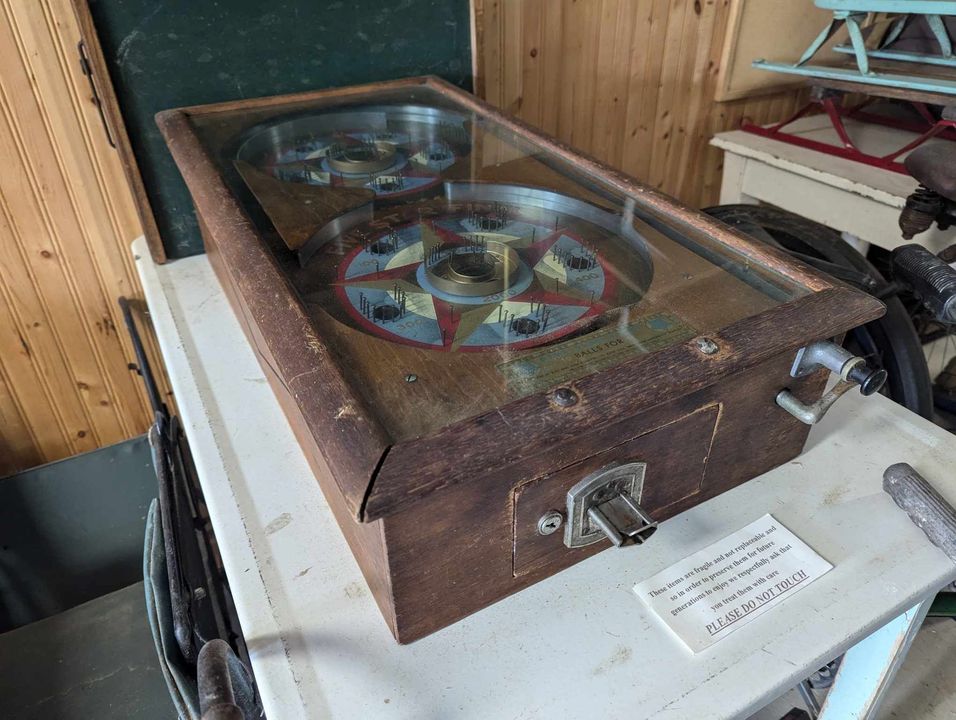
Bagatelle
Pinball traces its roots to bagatelle, an 18th-century French parlour table game that challenged players to use a stick to shoot balls across a table filled with pins and scoring holes. But modern coin-operated pinball machines originated in 1931 as American manufacturers separated players from the bagatelle board (or “playfield”) with a piece of glass, incorporated mechanical systems to remove balls from the playfield, and added a coin mechanism to monetize game play. Later that year, David Gottlieb’s Baffle Ball helped ignite the pinball craze of the 1930s as the games entertained millions of people during the Great Depression.
The origins of Bagatelle are even less clear than most games of a similar history although, since the name is a French one, the most obvious guess is a French derivation. Anyway, from 1820 to 1900, it seems that the Bagatelle was just as popular as Billiards throughout England and Britain. The journals of John Thurston, one of the leading manufacturers of Billiards tables in the 1800s, show that he made a large number of Bagatelle tables between 1818 and 1845. To add to the mystery further, the French version of his catalogue refers to the game as “Billiards Anglais”, from which this author deduces that the French connection is either much older or is a red herring. In this latter year, the game joined the long list of restricted and banned games when a Gaming Act decreed that there should be “no play on a public billiard table or bagatelle table from 1 am to 8 am and on Sundays, Christmas Day and Good Friday”.
Bagatelle became very fashionable during the Victorian era and numerous games were produced for the home. These tended to be smaller than the pub games and often folded up for easy storage but most were high quality articles.
The name Bagatelle these days is far more likely to conjure up the image of the children’s pastime wherein marbles or ball bearings are shot onto a board which features areas fenced in by nails hammered into its surface. Each container scores different points depending upon the likelihood of a ball finishing in it. An entertaining game, generally considered to be for children, the resemblance to the original pub game is not overwhelming. This smaller version began to appear in the late 19th century. The similarities are that the players shoot balls from the square end of the board towards the semi-circular end of the board with the objective of getting the balls to land in scoring holes and areas on the board surface. However, the whole board has been miniaturised to a tabletop size (in the same way that Shovelboard became Shove Ha’penny and Skittles begot Table Skittles). Presumably because aiming the balls was too difficult for youngsters, the balls run up a channel on the right hand side. The targets are enlarged by virtue of surrounding nails and the elements of skill have generally been almost replaced by that of luck. No points are scored if the balls roll right back down to the bottom edge of the board. Early boards required the balls to be struck up the channel by a cue in the same way as for the adult game. Modern games usually feature a sprung plunger as an alternative or a replacement to the more traditional stick. This author has read that Montague Redgrave patented a spring loaded plunger mechanism to launch the ball in the year 1870.
Pin Ball
It takes less of a leap of imagination to jump from Children’s Bagatelle to modern-day Pinball machines of the sort that have graced any self-respecting amusement arcade from the 1930’s onwards. The traditional quiescent scoring mechanism is replaced by transient electronic method whereby the balls score points as they travel around the games surface, rather than scoring when they come to a halt. And the skill level is greatly increased because the balls can now be knocked back into play by flippers at the front of the game. But the plunger knocks the ball into play up a chute on the right, the balls are dead when they roll down to the area at the front of the game and scoring is achieved by getting the ball to roll into scoring holes and areas on the game surface itself in exactly the same way.
Five Star Final was produced by Gottlieb, D. & Co. in 1932.
Other machines made by Gottlieb, D. & Co. during the time period Five Star Final was produced include: Test Your Grip, Baffle Ball Home Game, Treasure Island, Treasure Hunt, Trading Post, Chuck-O-Luck, Five Star Final Junior, Five Star Final Senior, Flying Trapeze, and Fortune & Ball Gum


Gottlieb® History
Gottlieb Development LLC, a New York limited liability company, is the successor to the proud Gottlieb® pinball tradition begun in 1927 and continuing to the present day. Through use of the famous trademarks, Gottlieb®, D. Gottlieb & Co.®, and Premier®, Gottlieb Development has kept alive the vaunted Gottlieb® memories of earlier times, while adapting the brand to the new technologies of today.
D. Gottlieb & Co. was established by David Gottlieb in 1927 as an arcade game corporation. It produced primarily pinball games, but also produced various other games including pitch-and-bats, bowling games, and, eventually, under its successors, video arcade games as well. During World War II the company geared up for war production, as did so many other companies recruited to the fight for freedom.
Like some other manufacturers of the day, D. Gottlieb & Co. first made mechanical pinball games. Then, starting in 1935, it produced electromechanical games. In 1947, D. Gottlieb & Co. was the first company to incorporate flippers on the pinball playfield to give the player more control over the play of the game. To this day, in many other countries pinball machines are known as “flippers.” The flipper feature is what makes a pinball machine a pinball machine.

During the 1930s and 1940s pinball designers and manufacturers introduced new features such as electrified scoring bumpers, chimes, and bells to add excitement. Playfields and “backglasses” positioned at the back of the playfield provided pinball manufacturers and artists with blank canvases for vibrant visuals often centering on popular trends, industry, fairy tales, and young women meant to appeal to mostly male players. The addition of electromechanical flippers on Gottlieb’s 1947 game Humpty Dumpty gave players the ability to control, aim, and fire a pinball across the game’s playfield. Flippers transformed pinball from a mostly static game of chance derided by social reformers who made it illegal in some parts of the United States to a dynamic game of skill that encouraged players to transfer the skills they acquired playing one game to another game.
In 1931, carpenter Arthur Paulin and salesman Earl Froom crated Whiffle, a coin-operated, glass-covered game that recirculated its balls after play. When shooting marbles into scoring holes proved popular with the public, dozens of companies, including pinball popularizers Gottlieb and Bally, produced games of their own.


Leave A Comment