
Broom Sewing Machine
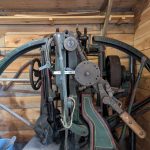
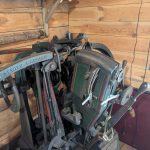
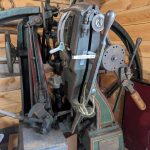
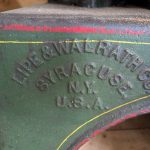
- The March 1916 “Brooms, Brushes & Handles” features an ad for the “Lipe-Walrath Broom Sewing Machine” from the Lipe & Walrath Co.
- This company was incorporated in 1906 by W. C. Lipe and L. G. Ford of Syracuse and A. A. Walrath of Fort Plains, NY, and succeeded the partnership of W. C. Lipe and “the late Alphonzo Walrath”.
- The company made broom sewing machines.
- Alphonzo Walrath, who died 1904-05-31, had several patents on broom making machinery and owned a plant in Fort Plain in addition to his interest in Lipe & Walrath.
As the head of the Alphonso Walrath Company of Fort Plain, Montgomery County, Alton A. Walrath is conducting the prosperous manufacturing business founded by his father half a century ago. Alphonso Walrath, the father, was born in Montgomery County, reared and educated here and in Little Falls. An inventor by profession, he was successful as a manufacturer of machinery he devised or improved and in 1872 founded the business the son now runs under his name. Among his inventions was one of the first broom sewing machines which, it is interesting to note, is still in operation in California. In collaboration with W. C. Lipe of Syracuse he invented the Lipe-Walrath “screw-feed” broom sewing machine which is today the most improved and modern piece of machinery of its kind. Mr. Walrath is also a stockholder and director in the Lipe & Walrath Company of Syracuse, machinery manufacturers, whose factory is one of the largest in the city.
History of Brooms
There is no exact date that marks the invention of the broom. The initial origin of bundles of twigs tied together and attached to a stick dates back to biblical and ancient times when brooms were used to sweep up ash and embers around fires.
Before 1797, brooms in America were home and hand-made. Tree branches and brush were often used to sweep the floor and clean the ashes from the fireplaces. Sometimes a crude brooms were fashioned by tying something on a stick or handle: straw, hay, fine twigs or corn husks. These crude brooms did not sweep well and fell apart after a short time, even though strong linen twine was often used.
The sweeping quality of brooms changed in 1797 when Levi Dickenson, a farmer in Hadley, Massachusetts, made a broom for his wife, using the tassels of a variety of sorghum (Sorghum vulgere), a grain he was growing for the seeds. She thought Levi’s broom was exceptionally good and told friends and neighbors about it.
In 1810 the foot-treadle broom machine was invented. This clever machine played an integral part in the Industrial Revolution.
While developing the broom machine, its inventors also examined the broom handle, looking for a better way to secure the sorghum tassels to it. These inventors drilled two holes in the handle and inserted split pegs into the round holes. The broom corn was lashed onto the handle and pegs, using linen twine.
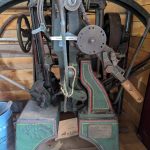
By the first few decades of the 19th century, a number of versions of the “broom machine”—a set of vices, clamps and a foot treadle (essentially a tension apparatus that uses the broom-maker’s feet to keep a roll of twine taut as he winds it around the broom corn)—had been developed that made broom manufacturing even quicker.
Many copies of the 1810 broom machine were made, and soon many one or two man broom shops were making thousands of round brooms each year.
The Shaker intervention—the only major update to the broom since the introduction of the broom machine—was simple but ingenious: Instead of lashing the broomcorn in a round bundle to the handle, they found that securing the corn with wire, flattening it with a vice and sewing it tight resulted in superior cleaning tool. Flat brooms offered increased control over the broom’s motion and a broadened surface area.
With the advent of the broom machine and the Shaker design, broom-making’s popularity spread rapidly across the United States,


Leave A Comment